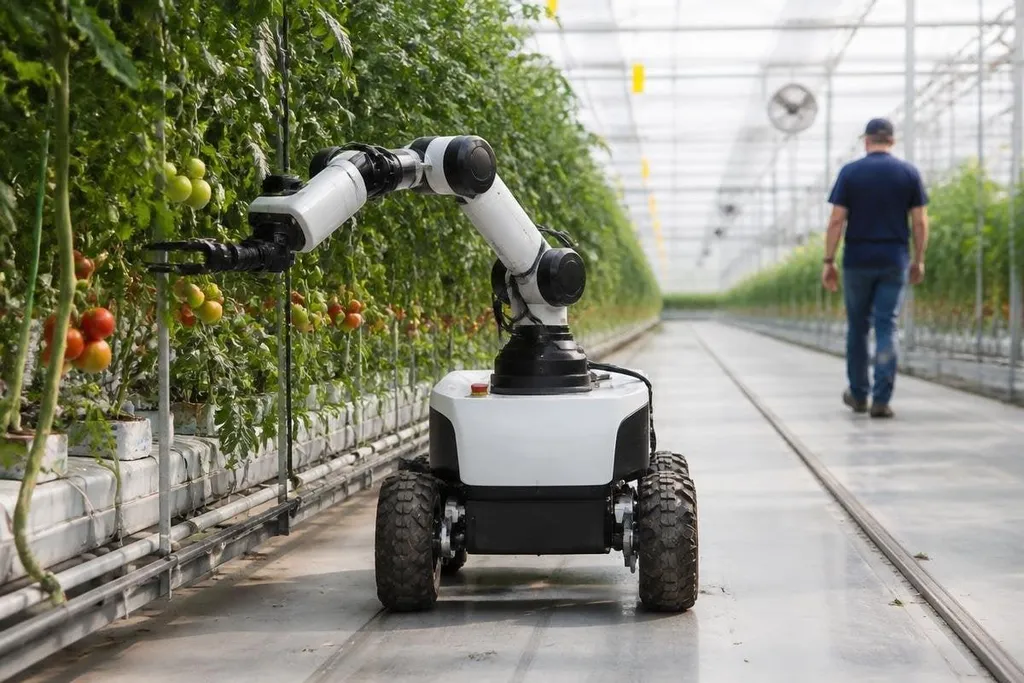
A greenhouse robot has a harder job than a clean demo suggests. It must move through narrow rows, handle living plants without damage, and keep working when light, humidity, and floor conditions change.
For a grower deciding where to spend money, the useful question is simple: what can the robot do for a full workday, and what does it still need from people?
- A useful test measures crop damage, task speed, and stoppage time.
- Payload in kg, position error in mm, and runtime in hours matter more than polished video.
- Any purchase case needs field results from the crop and layout you use.
The work is harder than the demo
Greenhouse tasks vary by crop and growth stage. A robot that carries trays may not suit a system that needs gentle picking, leaf inspection, pruning, or targeted spraying. Each job needs its own test, since a machine can perform well on one task and fail on another.
The setting adds more problems. Plants block sensors, wet surfaces reduce traction, and narrow paths leave little room for recovery. Cameras, depth sensors, or LiDAR may help the robot build a map and keep its position. Those parts help it move, but they don't prove that it can finish useful work.
The hand or tool at the end of the arm matters just as much. A gripper must hold the target without bruising it, while a cutter or sprayer must reach the right point without touching nearby growth. The test should record damaged plants, missed targets, and manual fixes after each run.
What a fair test measures
A grower should ask for results from the same task repeated across real plants, not a single successful attempt. The report should state the crop, row width, lighting, floor surface, task count, and time spent on setup.
Those details let you compare a robot with the people already doing the work. They also expose costs that a sales video can leave out, such as remote control, sensor cleaning, battery changes, software setup, and recovery after a stop.
For greenhouse buyers, Robot24.com greenhouse robotics coverage can connect a machine’s crop, task, test date, and measured result to the firms and labs behind it. That gives you a way to judge a quoted picking rate before the next check counts crop damage, stop time, and human work.
A useful report should show task rate in plants, trays, or meters per hour; damage from dropped, cut, or bruised crops; stop time caused by blocked paths, lost positioning, or empty power; human time for setup, supervision, and recovery; and results from more than one crop row or work area.
These measures answer the question a spec sheet cannot: does the robot reduce paid labor without adding a second job for the grower?
Where the race can go wrong
Competition can push companies to publish more results, but it can also reward the best-looking demo. A video may show a robot picking one clear target under fixed light. That says little about the same task after leaves overlap, fruit moves, or a worker leaves a cart in the path.
Remote control needs a clear label too. Teleoperation means a person guides the robot from a distance. That can help during early trials, but the labor cost remains if a worker must watch every movement or take control several times each hour.
The same care applies to autonomy claims. Movement may work on its own while a person still chooses targets, checks crop quality, or clears faults. Those roles should appear in the test plan rather than disappear behind the word autonomous.
A buying checklist for growers
Before a trial or purchase, ask the supplier for these details:
- Name the crop and task used in the test.
- Record speed, damage, stops, and human intervention.
- Check payload, reach, position error, battery runtime, and charging method.
- Price the robot, gripper, sensors, software, service, and training separately.
- Run the machine in your rows before signing a long contract.
The supplier should also state what the robot cannot do yet. Missing data is a result in its own right, especially when the proposed job affects saleable crops.
What happens next
Better greenhouse robots will be judged by repeatable field records, not by how many companies enter the race. Until a machine publishes task rate, crop damage, stop time, and human labor for the exact work you need, treat the purchase as a trial rather than a finished automation plan.